Monday, 8 May 2023

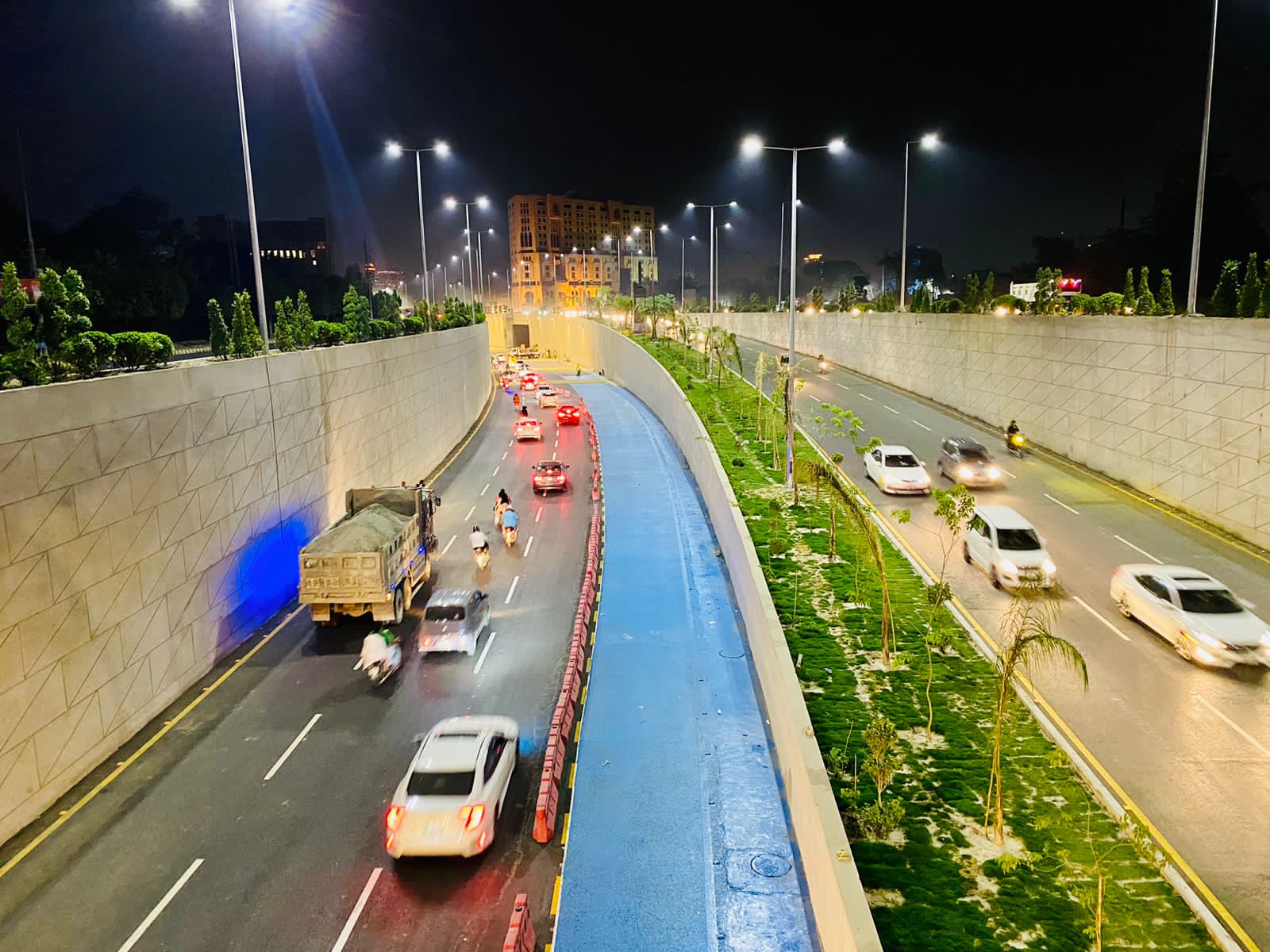
CBD PUNJAB MADE HISTORY KALMA UNDERPASS AND CBD PUNJAB BOULEVARD COMPLETED IN 5 MONTHS


The Punjab Central Business District Development Authority (PCBDDA) also known as the Central Business District Punjab (CBD Punjab) has made history by completing the Kalma Chowk Underpass and CBD Punjab Boulevard project in just five months. This remarkable achievement is a testament to the hard work and dedication of all those involved, from the CBD Punjab team to various institutions and stakeholders who cooperated to bring this project to fruition.

The project was completed by the given deadline as per the directive of Caretaker Chief Minister Punjab Syed Mohsin Raza Naqvi, to provide relief to the daily commuters from  traffic congestion in the area and provide a smoother flow of traffic 

CEO of CBD Punjab Imran Amin expressed his gratitude to all those involved in making this project a success, including the caretaker Chief Minister Punjab Syed Mohsin Raza Naqvi, Caretaker Minister Housing Urban Development Punjab,Syed Barrister Azfar Ali Nasir, Caretaker Minister C&W Punjab, Bilal Afzal, Commissioner Lahore, Muhammad Ali Randhawa, Deputy Commissioner Lahore, Rafia Haider, Chief Secretary Punjab, Zahid Akhtar Zaman, Secretary Housing and Urban Development Punjab, Captain. (R) Muhammad Zafar Iqbal, Secretary Planning Punjab, Muhammad Sohail Anwar Choudhary, as well as institutions such as WASA, LESCO, Traffic Police, PHA, NLC, and Nespak, and Habib Construction for their cooperation and support throughout the project.

The people of Lahore also played a critical role in the success of this project. Their cooperation and patience during the construction phase were instrumental in ensuring that the project was completed within the designated timeframe.

The completion of the Kalma Underpass and CBD Punjab Boulevard project is a significant milestone for CBD Punjab and a testament to the organization's commitment to delivering 

high-quality infrastructure projects that benefit the communities it serves. The inauguration of the project is eagerly awaited, and it is expected to be a proud moment for everyone involved in this remarkable achievement.

Friday, 5 May 2023

Organisations urged to improve risk culture following unique global research


As corporate collapses make headlines this year the need for strong risk management is clear. This is why the Association of Chartered Certified Accountants (ACCA), The Association of Insurance and Risk Managers (Airmic), and the Professional Risk Managers’ International Association (PRMIA) have collaborated on a new study that gauges how risk and financial leaders are dealing with risk culture and to what extent they understand its effect on the organisation’s broader strategy.


The research is based on an online global survey complemented by a mix of interactive engagements with the three professional bodies’ respective members, gathering views from thousands of risk and financial professionals around the world. The findings are published in a new report, Risk Culture: Building Resilience and Seizing Opportunities. Read the full report and its supplements here.


This first of its kind study found that while ‘box ticking’ is prevalent there is growing interest in risk culture to cope with disconnected organisational cultures and hard-to-detect breadth of risks.


Key risk priorities for risk and finance professionals across all regions were ‘regulatory, compliance and risk’ followed by ‘technology, data, cybersecurity’ and ‘economic inflation and recession’.


Sector-specific results showed respondents in financial services were more likely to raise ‘technology, data and cybersecurity’ and ‘regulatory, compliance and legal’ as their two highest risk priorities, whereas those in the corporate sector ranked ‘logistics and supply chain’ issues as one of their top three risk concerns. Interestingly, despite a rise in corporate fraud cases, the corporate sector ranked ‘misconduct, fraud and reputational damage’ lower than any other sector.


Some of the overarching concerns coming out of the report are that risk conversations continue to happen in a vacuum at the top of organisations, and that engagement not only between boards and senior management  but also across functions and roles  needs significant improving.


‘Recent corporate collapses remind us of how inadequate and siloed risk governance can be, regardless of what is said in their financial statements,’ said Rachael Johnson, head of risk management and corporate governance at ACCA and author of the report. ‘As our research shows, it is not only the regulators who are asking questions. In today’s highly interconnected, digital world, even a weak risk culture is better than none.’ 


‘In an increasingly high velocity, complex and connected world, tensions can be created between managing performance, innovation, controls, and assurance.’


Julia Graham, CEO of Airmic, a partner said: ‘This report addresses how risk culture can contribute towards managing these tensions as part of good governance and concludes that managing risk dynamically and building resilience collaboratively are changing risk culture for the better.’


‘Recent events, such as FTX and Silicon Valley Bank, show us that risk culture, more than ever, needs to be front and center for risk and accounting professionals,’ said Justin McCarthy, CEO of PRMIA. ‘This report shows how we need to help our respective members work and learn together more.’


The report incorporates insights from over 2,000 risk and financial professionals around the world. The online survey took place in October 2022 and attracted 1,823 individual responses from risk and financial professionals globally, across a range of industries. The majority of these individuals have accountancy backgrounds (93% being ACCA members). Additional forums, roundtables and one-on-one interviews with more ACCA members contributed further qualitative data.


A supplementary document to the report  Risk Culture Conversations – digs into the two open-ended questions from the survey as well as these discussions and input from our online community pop-up platform, which took place in November 2022.


To complement the findings, the report also includes ten calls to action.


  1. Empower risk leaders to drive risk culture and influence behaviours.
  2. Resist the danger of tunnel vision when faced with a multitude of risks.
  3. Understand the behaviours driving both good and bad outcomes.
  4. Don’t mistake a ‘tick the box’ compliance approach as true, value-added risk management.
  5. Consider how you define the role of accountants in risk culture, particularly on reconciling ethics with profits.
  6. Define risk appetite clearly and communicate its purpose to help guide behaviour and inform better decision making.
  7. Eliminate the fear factor by creating a ‘hands up’ culture through visibility and leading by example.
  8. Measure and incentivise the risk culture you want by ensuring ‘everyone owns it’.
  9. Promote good governance through role clarity and knowing who is responsible and accountable for what.
  10. Coordinate multi-stakeholder engagement with regulators leading to more positive, pro-society outcomes.


ACCA will publish additional research on risk culture by industry throughout 2023.


GameNow FFSIQ Winners Team Legacy earns the right to represent Pakistan at the FFSI in Thailand


Free Fire Pakistan’s newest format esports league, the GameNow Free Fire Sea Invitational Qualifiers has come to an end, with a new team joining the champions list, Team Legacy. The tier-2 league ended in the most dramatic finish with two-time FFPL champions Team Hotshot Esports coming in at second with only 4 points between the two.

Team Legacy consisted of disgruntled members from various esports teams who came together to form a new team. They have earned the right to represent Pakistan at the Free Fire Sea Invitationals to be held later this month in Thailand where they will be competing against top teams of various regions.


Jazz GameNow and Free Fire embarked on their partnership with the launch of the GameNow FFSIQ in April. Free Fire is the world’s leading mobile battle royale game with over 1 Billion downloads and has been at the forefront of the esports revolution in Pakistan.


Speaking at the event, Kazim Mujtaba, Chief Commercial Officer at Jazz, said, “As a digital-first company, Jazz is committed to creating and bolstering avenues of digital growth in Pakistan. For Pakistan in 2023 alone, the revenue in the online gaming market is estimated to reach over $46 million, and by 2027 this value is predicted at nearly $73 million. These numbers indicate lucrative global opportunities for our youth and a tremendous potential for economic uplift, and Jazz is determined to help materialize this through Game Now.

Wednesday, 3 May 2023

Punjab's Caretaker Minister Lauds CBD Punjab's Progress in Modernizing Lahore's Infrastructure Development


Caretaker Minister for Housing and Urban Development Punjab, Barrister Syed Azfar Ali Nasir, paid a visit to Punjab Central Business District Development Authority (PCBDDA), also known as Central Business District Punjab (CBD Punjab), where he was briefed on the CBD Punjab's projects, especially the CBD Punjab Boulevard and Kalma Chowk Underpass remodeling. 

CEO CBD Punjab, Imran Amin Executive Director Commercial CBD Punjab, Mohammed Omer, Executive Director Technical CBD Punjab, Riaz Hussain, Director Business  Development CBD Punjab, Ali Waqar Shah , Director Project Management CBD Punjab Asif Iqbal, Director Construction CBD Punjab, Asif Babar, officials of NLC and  Nespak were also present during the visit.

The Caretaker Minister visited the under-construction barrels of CBD Punjab Boulevard. CEO CBD Punjab, Imran Amin and Executive Director Technical CBD Punjab, Riaz Hussain updated the Caretaker Minister about the development work progress. Caretaker Minister showed his satisfaction and praised the efforts of CBD Punjab to complete the project on the timeline given by Caretaker Chief Minister Punjab Syed Mohsin Raza Naqvi.

Speaking with media, Caretaker Minister lauded the CBD Punjab's commitment to delivering the project on time and to a high standard of quality. He also noted the significant impact that the project would have on the city's economy, as it would make it easier for people and goods to move around the city and would attract more investment and business opportunities to the area.

The CEO of CBD Punjab, Mr. Imran Amin, expressed his confidence in his team's ability to complete the project as per the timeline and to the highest possible standards. He highlighted the dedication and hard work of the CBD Punjab team and expressed his gratitude to Government of the Punjab for their support and encouragement. He also emphasized the CBD Punjab's commitment to making history in the capital of Punjab, and to creating a world-class business district that would attract investment, tourism, and innovation to the region. He noted that the Kalma Chowk Underpass and Boulevard Project was just one part of the CBD's broader vision for Lahore, which included the development of new commercial and residential spaces, modern transportation infrastructure, and state-of-the-art technology and communications systems.

Overall, the briefing session highlighted the important role of CBD Punjab in modernizing Lahore's infrastructure and positioning it as a global hub for business and innovation. Government of the Punjab and CBD Punjab expressed their commitment for continuing to work together in achieving this vision and to create a brighter future for the people of Lahore and the region.


Tuesday, 2 May 2023

CBD PUNJAB INTRODUCES "BLUE ROAD" CONCEPT FOR MODERNIZING CITY INFRASTRUCTURE


Punjab Central Business District Development Authority (PCBDDA), commonly known as Central Business District Punjab (CBD Punjab), is proud to announce the introduction of the "Blue Road" concept in Lahore. The concept aims to modernize the city's infrastructure and improve the quality of life for its residents.

CBD Punjab has introduced the Blue Road concept to Lahore, marking the first city in Pakistan and Asia, to adopt this innovative technology. Blue Roads are designed to offer a sustainable alternative to traditional asphalt roads, incorporating heat observation and energy-conserving features to reduce pollution and promote a healthier environment. These innovative roads utilize a specialized coating that reflects sunlight, reducing the amount of heat absorbed by the road surface. In addition, the reflective coating improves visibility for drivers at night, improving road safety. 

Under the leadership of Imran Amin, CEO of CBD Punjab, the construction work is being personally monitored to ensure the timeline given by the caretaker Chief Minister of Punjab, Mohsin Raza Naqvi during his last visit is met.

While expressing his views CEO CBD Punjab Imran Amin said, "We are excited to introduce the Blue Road concept in Pakistan, which has already been implemented successfully in several European and Middle Eastern countries like  Netherlands, France and Qatar. This project will not only bring environmental benefits, such as heat observation, energy conservation, and reduced pollution, but also contribute to our vision of creating a modern, sustainable, and inclusive society in Punjab."

CBD Punjab is committed to delivering projects that enhance the standard of living for its residents. The introduction of the "Blue Road" concept is just one of many initiatives that the authority is undertaking to modernize the city's infrastructure and improve the quality of life for its citizens.

Friday, 28 April 2023

realme 11 Pro Series 5G Confirms its Launch with a Brand-new Master Design


realme, the world’s fastest-growing smartphone brand confirms the official launch date of its realme 11 Pro Series 5G. Coming in two variants - realme 11 Pro+ 5G and realme 11 Pro 5G, the stellar new lineup will be released on May 10th. 


realme 11 Pro Series is collaboration between realme Design Studio and Matteo Menotto - former Gucci Prints designer, realme 11 Pro Series 5G comes with a striking-new master design, featuring an elegant lychee leather back and a lace-like strip circles its camera module and goes straight down to the bottom. According to Matteo, the design inspiration comes from Milan, a fashion-forward city and also where Matteo grew-up. He took inspiration from the beautiful monuments in the city, where the rising run drapes classic architectures and creates a pale golden hue, just like the new phone’s colour variant - Sunrise Beige. Aside from Sunrise Beige, realme 11 Pro Series 5G also offers Oasis Green and Astral Black - a total of three dynamic colour variants. 

Together with realme Design Studio, Matteo brings texture, prints, and craftsmanship that are usually seen on luxury items. So aside from a premium lychee leather back, realme 11 Pro Series 5G also uses a 3D couture-level seam technique and an industry-first 3D woven texture to create a unique and premium grip feeling in hand.

Thursday, 27 April 2023

Economic confidence rebounds as fears fade over 2023 recession


Economic confidence is rising across the globe as clear signs of business improvement emerge.

While the Q1 2023 Global Economic Conditions Survey (GECS) shows confidence lower than a year ago, it rose for the third consecutive quarter as fears fade over the prospects of a recession in 2023.


This better news is underlined by the two GECS “Fear’’ indices which reflects respondents concerns that customers and/or suppliers may go out of business. Both these series improved on Q4 2022. Indeed, worries about suppliers have fallen to the lowest level since 2020. And although new orders have flatlined this quarter, the survey showed improvements in both employment and capital expenditure (capex).


Although with Central Banks still raising interest rates and the delayed effect of monetary policy tightening on the real economy, as well as recent challenges in the banking sector, it may be premature to sound the “all clear.” 


Jamie Lyon, head of skills, sectors and technology at ACCA, said: “The global economy entered 2023 with more momentum than many had expected. Confidence has risen as business comes to terms with the fallout from the Russian-Ukraine war. The economic climate has been helped by a faster-than-expected relaxation of China’s zero-COVID policies, and more normal energy prices in Europe, that should help to reduce headline inflation and may bring about a pause in Central Banks’ tightening of monetary policy, but there are still some downside risks that may prevail.


Loreal Jiles, vice president of research and thought leadership at IMA, said: “Looking at the change in the GECS Confidence Indices over the quarter, what stands out is the 30-point improvement in Confidence in Western EuropeHowever, this good news was not limited to Europe; Asia-Pacific, North America and South Asia also registered an improvement. This was a broad-based pick-up, with the exception of Africa and the Middle East.”


Although Global New Orders are flat-lining, one factor sustaining the rebound in Confidence may be the decline in the level of concern about “increased costs.” Cost pressures look like they may have peaked, although they still remain well above the median recorded over the survey’s history. Commodity prices remain subdued, and Europe has benefitted from natural gas prices returning to levels seen before Russia’s invasion of Ukraine.


Global confidence has edged up for the third consecutive quarter, not only because cost concerns have eased, but also because worries about accessing finance and securing prompt payment have declined.


Indeed, reports of problems with prompt payment fell to the second lowest level in the survey’s history. The improved macro conditions also appear to have encouraged companies to revisit their capex and hiring plans.


When asked how they planned to respond to the changing economic environment, the net balance of companies planning to increase investment in capital and staff rose on the quarter, as did the net balance of companies planning to increase job creation.


This is something of a surprise given the rapid tightening of global monetary policy by the world’s Central Banks. The past 12 months have seen the most aggressive simultaneous tightening of policy in more than 40 years in terms of pace, scale, and breadth. It is curious that this has not yet had a material impact on financing conditions and corporates’ capex and hiring intentions. But monetary policy works with long and variable lags, which suggests that this could still become a problem later in the year.